Showing posts with label opinion. Show all posts

Thursday, May 19, 2016

Quality vs Cost

"Flight training is too expensive."

I've heard that phrase so often in the years that I've been flying that it is engrained in my psyche. Flight training is too expensive, flying is too expensive. We must make things cheaper so we can get more pilots in the air. It costs too much to pay $125 or $150 every two years to see a medical examiner. Requiring a flight instructor to work with an instrument pilot on instrument currency requirements in a simulator is a "burden". AOPA and even the FAA use these terms and herald any chance to make flying and flight training less expensive as a win for the aviation industry. The Sport Pilot Certificate and the Pilot's Bill of Rights 2 are two examples. In the latest NPRM from the FAA says, "it can be expensive to hire a flight instructor".

Like a good soldier I march forward, with those words burned into my brain. Now, as a CFI, I feel responsible to provide a successful training experience to my students. I realized recently I am so deeply programmed by the "flight training is too expensive" mantra that I have unconsciously compromised on my training plans to try to make the training cheaper for my students. I've tried to combine training that shouldn't be combined, for instance. Or not told them I felt additional training was needed because it was not directly related to the instruction I was hired to provide.

Today I feel my students and I are very fortunate because in the occasions where I tried to compromise in order to make things cheaper, circumstance forced me to end up doing what I knew was right anyway. The resulting situations forced me to opt for separating the training tasks as they should have been in the first place and suggesting additional training because I could no longer deny the students really needed that training. You know what happened as a result? They were happy to accept the suggestion of additional or separate training without the slightest argument. Not once did they say, "this is too expensive". I was bending over backwards trying to make flight training less expensive when I should have been focusing on making the training I provided as valuable as possible.

Frankly I'm tired of the "flight training is too expensive" mantra. Yes, flight training is expensive and we would all benefit if it was less so. But focusing on cost alone is missing the mark entirely. AOPA's been trying to figure out ways to reduce the cost of flight training for decades. To what result? A pilot's certificate with limited privledges that you can earn in half the hours which everyone knows still takes way more than the 20 required. What would happen if AOPA and the FAA focused on ensuring the time spent flight training was better spent? What if we focused on creating quality flight instructors who provided real value with every flight. Who created safe, proficient and constantly learning pilots? What if the FAA insisted on CFI's interjecting real life scenarios into ATD instrument currency work instead of removing the CFI from the equation because it's "too expensive"?

One thing my brief experience in flight instructing has taught me is (and yes, my flight instructor told me this too) never compromise my standards. If I compromise my standards to reduce cost, I also reduce the safety and proficiency of the pilot I'm training. I reduce the value I'm providing.

I am glad that I've discovered this bias in myself and can guard against it now. I wonder how many other well meaning CFIs are doing the same thing? I wonder if pilots would fly safer and smarter if the CFIs training them were hounded to increase the quality of the training they provide rather than to find ways to cut corners every way they can to reduce the cost?


Monday, June 22, 2015

Success and Shooting Stars

Aviation is a complex world... to master flying one must master the invisible world of the air. The world in which aviators work and play is ever changing, and, like I said, its invisible! We have to learn how to observe and feel the actions of the aircraft - the slight vibration in the controls right before inducing a stall, the speed the ground slips below the wings or rises to meet us on final approach. We can't see the air, all we can do is read its signs around us.

I was thinking today of what can guarantee success in aviation and actually I don't think there is a guarantee of success in aviation. There are characteristics or traits that can definitely increase likelihood of failure, however. The FAA talks about the "five hazardous attitudes" Macho, Impulsiveness, Anti-Authority, Resignation, and Invulnerability. All people have these attitudes at one point or another and one of the keys to success is recognizing and countering the attitudes when they occur.

I do think there are other traits or attitudes that are more likely to lead to failure, damage to aircraft or person, death perhaps ... things like laziness, sloppiness, lack of attention to detail, lack of caring. There more I see these types of traits in the aviation world the more upset I get. Pilots who skip weather briefings because they're in a hurry and the sky is blue anyway. Pilots that crash their planes because they didn't bother to sump the fuel tanks after allowing a plane to sit a full winter. Pilots who don't notice they took off on the same tank they arrived on and end up running out of fuel short of their destination (only to have others discover one of the fuel tanks was full!) Pilots who leave doors unlatched on planes in storms, allowing water in to damage the interior. So-called instructors who don't prepare their students for the mental skills required to fly and survive in addition to the physical skills, who don't even completely train to meet the basic requirements for a certificate.

Serenity Prayer comes to mind... God, grant me the serenity to accept the things I cannot change, the courage to change the things I can and the wisdom to know the difference. One of the reasons I am pursuing my flight instructor certificate is because I believe I can change those that I touch... guide new pilots or even experienced pilots seeking improvement onto a path that will increase their likelihood of success, of survival in this invisible world. Not that I know everything or even that I'm a master of my craft, far from it. But I do know what is likely to kill the unwitting pilot and I believe I am starting to understand what makes a pilot an aviator.

Now I have to decide what to do about what I can't change. Do I stay around it for a while longer with hopes I can change it later? or do I separate myself from it so I do not have to face it day to day and be upset. So I do not have my name associated with these traits and their inevitable consequences. I don't know what I'll do.

The last sunset of spring.
However, I do not want to leave on a down note... I thought I would share a photo from a flight this weekend... the sunset over the bay on the last day of spring. I have a secret even better than the sunset. I'll share it with you, Don. After I contacted RHV tower for clearance to enter their airspace and turned towards San Jose from over the East Bay hills, a brilliant green streak flared overhead. Aligned directly with the longitudinal axis of my plane as I headed west. OMG I've been reading too many FAA texts!  It was a shooting star. Brilliant and mine, all mine.

As you all know, you get a wish when you see a shooting star. I figured I should get two since I saw one and I was right on its centerline :) So I made two wishes. I can't tell you what they were... but if you love flying as much as I do and followed my journey this far, you can probably guess.

Sunday, February 8, 2015

Woman Pilots - Some Data

The subject of "why are there so few women pilots" came up again this weekend. It comes up every so often and when it does it is usually someone citing data from 2010 saying only 6% of certificated pilots are women.  The roughly 6% number is correct when you look at FAA data for 2013. However, I think that isn't so dire as it appears. Not to say we don't need more women pilots, but bear with me for a discussion on some other data.  This data comes from the FAA Civil Airman Statistics for 2013.

Women as a % of Pilots by Age Group
42% of active pilots as of 2013 are 50 or older. I believe this fact is important because I believe the majority of pilots in this group came from the military. While the military did employ female pilots for some duties, there were far more male military pilots. When these military pilots retired they became the majority of the US civil aviation pilot population. It's no wonder women are such a small portion of the overall pilot population with the head start men have!

If you look at the number of women pilots when you narrow the age groups to under 50, under 40, under 30 and under 20 years old you find the women as a % of the total pilot population goes up.

Women account for 8.2% of the < 50 year old pilot population and that goes up to 13.7% of the < 20 year old population.


Women as a % of Student Pilots by Age Group
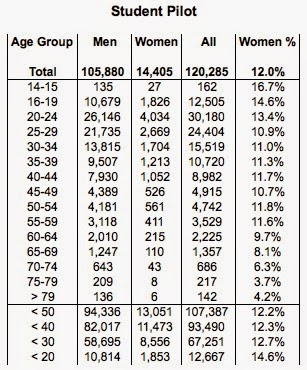
If you look at women as a % of student pilots the picture looks even better.

Women count for 12% of the entire student pilot population, thats almost double the 6.6% of the overall population.

We are 12.2% of the under 50 population and 14.6% of the under 20 population. We're 16.7% of the 14-15 year olds that are preparing to solo today! To me that's a great sign. Young women and teens today are not so hesitant to pursue a flying dream.

In fact, comparing these two tables, student pilots to all pilots, it appears women of all ages are pursuing the flying dream at a higher rate than our % of the general population.

It will be a long time before we overcome the effect of the military pilot surge and the general inertia of the "flying is not a job for women" bias of the early and middle 20th century. But I believe the tide is shifting. We need to work to continue that shift.

The thing I don't have data on, and I think I may have to contact the FAA to get it is, what % of women student pilots actually finish their private pilot training and earn their certificates compared to male students. My flight instructor, who's been instructing for 15 years now, says a much lower % of women finish than men in his experience. Do we learn differently? Do we need more support? More flexibility? Is he bad at training women? (I don't think so) It's a little project I'll do at some point - probably once I've finished my CFI training.

Wednesday, December 17, 2014

Just Showing Off

"Anything above 70% is just showing off," says a pilot on a forum to a student pilot who is trying to better his scores on practice tests to something above 85% consistently.

On one hand, I can see trying to ease the student's mind that he/she will pass with the scores the way they are. I totally understand there are people who just do not do well on tests, even when they do know the subject matter. Students need all of the encouragement and support they can get. A student pilot doesn't need to stress for a 100% on their written test, an 85% is fine. If they want to do even better, that's great in my opinion!

On the other hand, it irks me to no end when people denigrate the sincere efforts of others who are trying to excel.  Just showing off?! It's showing off to get more than 7 out of 10 correct on a test that is trying to gauge your knowledge of the things that you need to know in order to safely fly?

Who do you want to teach you how to fly? someone who goes for 70% on the written and accepts doing just enough to check the box as good enough? or do you want someone who takes the time to demonstrate they have the required knowledge of learning and the subject matter knowledge to teach.  Lets say you learn from that 70% CFI. The questions he missed on his knowledge test are likely to be the ones that he won't teach you, or won't teach you correctly.

It is true, whenever you miss any questions on the written tests, your CFI has to review the "areas of deficiency" with you and make sure you've learned what you missed. However, I believe the guy that is totally ok with a 70% score isn't too concerned about learning what he missed. The student pilot who is striving for better than 85%. He's a different story. I am pretty sure he will learn from his mistakes on the written and be a better pilot as a result.

[Sidebar: To be completely honest, it surprises me the FAA doesn't have a tighter standard on the written tests for CFIs than private, commercial and instrument pilots. How can we teach what we don't know? Aren't we the ones responsible to create those safe pilots the flying and non-flying public need?]

It was ironic seeing this exchange just days after I finally completed my first pass (of three) going through one of the study books for the CFI written test. After completing the first pass I know I could easily pass the written with a score better than 70%. However, that first pass also exposed some areas of knowledge I'm weak in. If I were that 70% pilot I'd go, take the test and merrily walk away with those knowledge areas left weak.

I'm not a 70% pilot and definitely will not be a 70% CFI. I am going to fill those knowledge gaps and get a much better than 70% score. It will take extra work, and it means that I won't be taking the written before then end of the year like I wanted. That's OK. I like showing off!


Sunday, January 26, 2014

What Makes a Good Pilot

I've been struggling with the question of what makes a good pilot for a while now. And, most important, of course, am I one? The question is harder to answer than it should be.

Ratings

You would think being someone with an Instrument Rating would make you a good pilot. Or having a Commercial Rating, CFI or ATP would guarantee "good pilot" status, but it does not. I've been around general aviation long enough now that I've met private pilots that I trust more than CFIs, that I think are better overall pilots. A different example... Are the ATPs who flew  a perfectly good 747 with hundreds of passengers straight into the sea wall at SFO last year good pilots? I wonder what they thought before that day and what they think now.

Bottom line, the certificate guarantees nothing. All it guarantees is a certain amount (not quality) of experience and training. If everything is done legally it also demonstrates the ability to pass a written knowledge test, the ability to pass an oral knowledge test and the ability to fly to PTS spec on a check ride. It gives one the opportunity to become a better pilot but does not ensure that result.

Experience

If certificates do not make a good pilot, is it hours of experience that do? I believe hours of experience provide the opportunity to become a better pilot than you would be without those hours. However there is no guarantee. Its not the quantity, its the quality of the experience. In my opinion the quality of the experience depends on what is learned from that experience.

An interesting case in point on both sides is John and Martha King of King Schools fame. They are writing a series of articles about Risk Management for Flying magazine. In those articles they're very candid about their risky flying and poor judgement as they quickly racked up hours of flight time up to the moment of an accident. During the time before their accident they had hours and experience but they did not learn from that experience to become safer pilots, they actually became more and more unsafe as they discovered they could get away with quite a bit if they were lucky. Their luck ran out and then they learned from all of that experience. They share their mistakes with others to hopefully make even better pilots up of us all.

Stick and Rudder Skills

Is it stick and rudder skills? Not necessarily. There are private pilots that have never flown a Lazy 8 and probably never will who are better pilots, in my opinion, than some commercial pilots that can perform that maneuver precisely. I do believe a certain level of stick and rudder skills IS required to be a good pilot. For instance the ability to recognize a problem or condition you don't want and make the correct correction quickly. The ability to take off and land a plane in a wide variety of conditions safely for sure. Hold a heading and altitude. Recognize a stall before it happens and recover. Navigate and split attention between flying the plane and everything else you have to do in order to avoid flying into that mountain or other plane. Stick and rudders kills are definitely a piece of what makes a good pilot, but not everything.

Judgement

Which brings up the question of judgement. I will argue the pilot with excellent stick and rudder skills and plenty of hours that flies deliberately into a squall line is not exercising good judgement and is not a good pilot, even if they survive the encounter. I will not knowingly place my life in the hands of such a pilot. Good judgement can make up for limited stick and rudder skills and experience as the fledgling pilot takes to the air after earning his or her PPL. Poor judgement can trump stick and rudder skills and experience at any time.

What Makes a Good Pilot

Here's my answer to what makes a good pilot. The foundation of being a good pilot is a combination of stick and rudder skills and judgement. These two give you a chance to become a good pilot.  Build on that foundation experience and honest learning from that experience to  develop even better stick and rudder skills and judgement. Then you become a better pilot. Keep building, layer upon layer, skills, judgement, mistakes, learning, self critique, correction, experience. Over and over again and you become an even better pilot. At some point you become a good pilot.

When you are a good pilot you consistently use your good judgement to operate within the limitations of your skills, your airplane, your mission and your environment. When you make a mistake, and you will, you learn the right lesson from that mistake. You are someone  worthy of the expectation of your passengers and even the non-flying public that you won't be "pilot error" cause of the accident that makes the evening news.

Are there great pilots? I think there are a few. These are those good pilots with years or decades of experience, skill development and learning. These pilots have learned and experienced enough to know no matter how good they are, they operate in an environment that can kill them. They know their skills, operate within their ever changing limitations, are humble and always learning.

What About Me

Am I a good pilot? I would say I'm on that path. I know my own limitations and operate within them. I'm consistently improving my stick and rudder skills and pushing myself out of my comfort zone so I can improve my skills with the help of my CFI. I strive to exercise good judgement and learn quickly when I don't. I am intensely aware of how much better I could be. I have much room for improvement and always will. Maybe the best way for me to describe myself as a pilot is, I'm always getting better :) I like that. If aviation was something with a "good pilot" line to cross, I would cross that line eventually and lose interest. I don't want to cross some finish line and be done with flying.

I leave you with two quotes that, I think, exemplify what a good pilot is.

"A good pilot is always learning."
"A superior pilot exercises superior judgement to avoid situations requiring superior skill."

Sunday, December 22, 2013

Flying Dinosaurs

Flying with Dinosaurs by mymindcircus
I remember a brief snippet of a conversation I had with my boss the day after I earned my PPL. He is a former military helicopter pilot. So he understood my exultation at finally earning my wings. He mentioned something in that conversation that surprised me though, something I remember to this day. He told me I am one of the last of the dinosaurs, the last of a dying breed. Someone who trained with so-called steam gauges for instruments instead of a glass panel.


I have to admit, sometimes I do feel a bit like a dinosaur. I have limited interest in the latest apps and aviation technology.  For VFR flying I could care less if a plane as a G1000 or a G430 or just a magnetic compass.  I prefer to look out the window over watching a screen. For IFR flying I care more about the GPS and other avionics and navigation aids in a plane. I would not fly in IMC without a fully functional IFR certified GPS in addition to my steam gauges. I know the steam gauges well and I know how they will fail, what they will do when they do and what I will do to continue the flight safely in that event.  I do use auto-pilot in IMC if my plane is so equipped but I turn the auto-pilot off between IAF and FAF, sometimes because I want to and sometimes because I don't know why the auto-pilot is doing what its doing but I do know how to fly the approach by hand correctly and safely so that's what I do. The thought of having a plane fly an entire approach "for me" does not excite me at all. I fly planes because I want to fly, not to be a passenger along for the ride.

When I look in the cockpit of new small jets and light planes with glass cockpits all I see is a faceless, blank pane of glass. No personality, no life to it without electricity. A plane with steam gauges has personality. Each plane is set up a slightly different way; every instrument with its own idiosyncrasies. The way the attitude indicator tends to lean to one side or the other when the gyros aren't running appears to be a plane at rest but with potential for flight. The other instruments seem frozen in time but ready to move at a moment's notice. I don't get that impression from a glass panel plane.

This doesn't mean people who fly glass panel planes don't love flying. I have a good friend with a very nice glass panel cockpit that loves flying just as much as I do. However, I do think there are new pilots, or even experienced pilots, that focus so much on flying the video game in the cockpit that they are missing out on the so called stick and rudder skills that are so important to safe flight. Especially pilots who have advanced autopilots they rely on to fly for them most of the time. Those pilots are really missing out and are becoming increasingly likely to have an incident or accident in the event of a systems failure or just a system not being set up right because they don't exercise the skills required to fly safely without the auto-pilots flying for them. A very painful case in point is the Asiana Airlines crash at SFO ( NTSB investigation site | wikipedia ) in July 2013.

From light GA planes with G1000 glass panels to complex passenger jets like the Boeing 777 that clipped the seawall at SFO crashed and killed 3 people in the process, pilots are in the cockpit to fly the plane, not watch the flight. If we don't want to become dinosaurs and eventually extinct as a career, it would do us all well to remember that.